
Homeschool Freedom: The School Choice Debate Over “Shekels” vs. “Shackles”

As public education funding reaches deeper into the school-choice movement, a long-running homeschool debate is becoming harder to answer with a simple yes or no.
For years, one phrase has circulated throughout the homeschooling world:
“With government shekels come government shackles.”
The idea is straightforward. If families accept public money to educate their children outside the traditional public-school system, the government may eventually claim a greater say in how those children are educated.
For independent homeschoolers who have spent decades protecting their freedom to choose their own curriculum, determine their own educational philosophy and operate largely outside the public-school system, the concern is not difficult to understand.
But in September 2026, the question is becoming considerably more complicated.
Across the country, homeschoolers are encountering a new landscape: publicly funded homeschool enrichment programs are being scrutinized, federal school-choice tax-credit rules are being finalized, and a new Oregon lawsuit is asking whether a public benefit available to homeschoolers can be conditioned on the religious character of the curriculum they choose.
At the same time, lawmakers in some states are pursuing homeschool-related regulations that have little or nothing to do with whether a family receives public money.
So perhaps the more useful question isn't simply whether shekels create shackles.
It is:
When does public funding expand educational freedom—and when does accepting that funding create a new relationship between a family and the government?
The debate behind the phrase

The “shekels vs. shackles” argument represents a genuine philosophical divide within the broader school-choice and homeschool movements.
One side sees public funding as a way to give families more options.
An Education Savings Account, scholarship, tax credit or publicly funded enrichment program can help a family pay for tutoring, curriculum, classes, educational therapies, extracurricular activities or other resources that might otherwise be financially out of reach.
The other side sees a potential tradeoff.
A family that is entirely independent of the government has fewer reasons for the government to determine what that family must teach, how it must teach it or how its educational progress must be documented.
Once public money enters the picture, however, policymakers can argue that taxpayers deserve accountability.
That creates a difficult question:
How much accountability is appropriate when the recipient is a family—not a government-run school?
That question is no longer theoretical.
The “shekels vs. shackles” argument represents a genuine philosophical divide within the broader school-choice and homeschool movements.
One side sees public funding as a way to give families more options.
An Education Savings Account, scholarship, tax credit or publicly funded enrichment program can help a family pay for tutoring, curriculum, classes, educational therapies, extracurricular activities or other resources that might otherwise be financially out of reach.
The other side sees a potential tradeoff.
A family that is entirely independent of the government has fewer reasons for the government to determine what that family must teach, how it must teach it or how its educational progress must be documented.
Once public money enters the picture, however, policymakers can argue that taxpayers deserve accountability.
That creates a difficult question:
How much accountability is appropriate when the recipient is a family—not a government-run school?
That question is no longer theoretical.
Colorado is showing what the funding question can look like in practice
One of the clearest examples is unfolding in Colorado.
Colorado has a relatively distinctive system in which families can participate in homeschool enrichment programs connected to public education funding. These programs can provide classes and other educational opportunities while children remain primarily educated at home.
But this year, that model has come under intense scrutiny.
In September, Colorado officials began working on new rules governing publicly funded homeschool enrichment programs. The state's nine-member State Board of Education is expected to finalize rules by December, with the new rules taking effect for the 2027–28 school year. Questions include whether private contractors should be permitted to operate state-funded programs and what guardrails should apply to organizations receiving public money.
Then came another development.

Make it stand out
Colorado Homeschool Enrichment, a program that had enrolled nearly 2,800 students across 48 campuses, announced in early September that it would not operate its publicly funded classes for homeschoolers this school year after its authorizer dissolved and the state launched a stricter approval process.
On September 22, Colorado officials also announced plans for third-party audits of the dissolved authorizing organization and its largest homeschool enrichment program.
This is an important distinction:
Colorado is not simply regulating every family that homeschools independently.
Colorado's existing law specifically distinguishes a parent-run, nonpublic home-based educational program from education under the supervision and control of a school district.
The current controversy is largely about the publicly funded layer surrounding homeschool enrichment.
And that distinction goes directly to the “shekels vs. shackles” question.
The more closely a homeschool program becomes connected to public funding, the more complicated the questions about authorization, accountability and oversight can become.
But here's where the argument gets interesting
If public money automatically produced government control, we might expect the greatest restrictions to occur wherever homeschoolers receive public funding.
The national picture isn't quite that simple.
There are also examples of governments attempting to regulate homeschooling because of concerns that have nothing directly to do with public funding.
West Virginia provides one example.
The state's controversial Raylee's Law debate centers on whether children should be permitted to leave public school for homeschooling while a child-abuse or neglect investigation is pending.
The proposal has generated a fierce disagreement between those who see additional safeguards as necessary to protect vulnerable children and homeschool advocates who worry that such restrictions could interfere with the rights of families who have done nothing wrong.
The measure failed to make it through the 2026 regular legislative session. But in September, lawmakers were again working on a new version in an effort to find a compromise.
Notice what is significant here:
The central issue isn't whether the homeschool family accepted an education voucher.
It is whether the state should have greater authority to intervene when it believes homeschooling could be used to conceal abuse.
That is a fundamentally different argument from the “government money equals government control” theory.
And it demonstrates why homeschool regulation cannot always be explained by funding alone.
Oregon presents another version of the question
Make it stand out
Then, this week, Oregon produced perhaps the most fascinating new example.
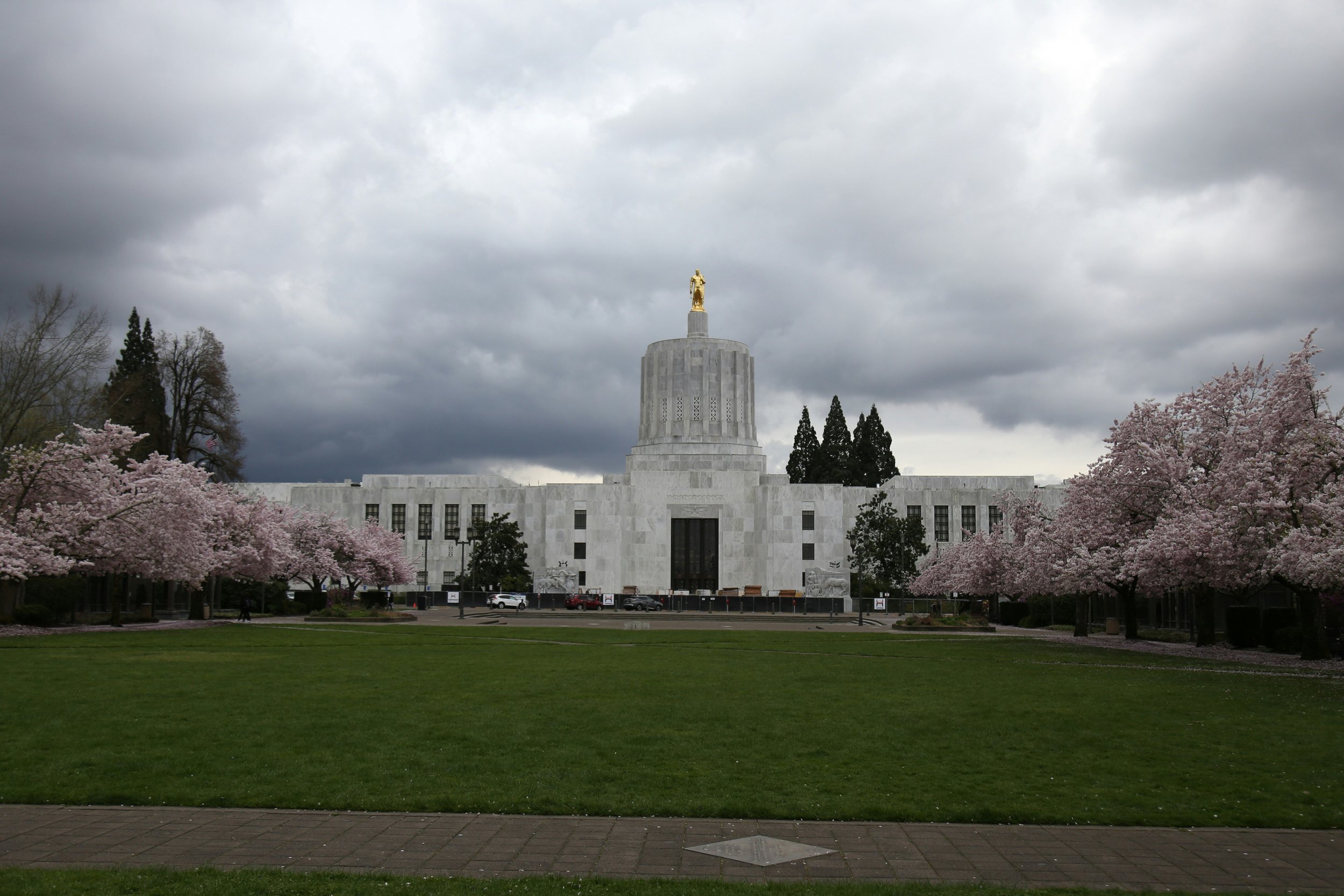
On September 23, attorneys filed a federal lawsuit against the Hillsboro School District on behalf of a homeschooling mother who says she was denied reimbursement for educational materials because those materials reflected a Christian worldview.
The district operates a Homeschooling Partnership that reimburses participating parents for certain educational materials and provides supplemental learning opportunities.
According to the lawsuit, the parent selected materials from Abeka and Classical Conversations and participated in a Christian homeschool cooperative. The district reimbursed some educational expenses but denied reimbursement for materials and classes because of their religious content.
The parent is now challenging that decision in federal court.
The case is significant because it illustrates a paradox of public funding:
The same government-funded benefit that can make homeschooling more accessible can also create questions about who qualifies for the benefit and what conditions can be attached to it.
Oregon's ordinary homeschool rules are actually relatively clear on one important point: families may choose their own curriculum, and they are not required to follow Oregon's academic standards.
But when a family participates in a publicly supported program, an entirely different set of legal questions can emerge.
What counts as an eligible expense?
Can a public program exclude religious curriculum?
Can government money be used for educational materials reflecting a particular worldview?
And if a family chooses not to participate in the program, does it retain a greater degree of independence?
The Oregon case does not answer those questions yet.
But it demonstrates why the funding debate is becoming increasingly consequential.
And then there is the federal tax-credit experiment
The timing is particularly notable because the United States is simultaneously preparing to launch a new federal school-choice tax-credit program.
Beginning in 2027, the federal Education Freedom Tax Credit will provide a dollar-for-dollar federal tax credit of up to $1,700 for qualifying contributions to scholarship-granting organizations. Participating organizations can provide scholarships for eligible educational expenses.
As of this month, the federal government is still working through the rules governing the program.
A September 23 report from The 74 noted that questions remain about how the program will operate as the White House reviews the final rules.
That matters enormously to homeschool families.
Earlier reporting has raised concerns that many homeschooled students could be excluded from the new federal program depending on how eligibility and allowable educational expenses are ultimately defined.
That creates an unexpected twist in the shekels-versus-shackles debate.
Some homeschoolers are asking:
“Will taking government money bring government control?”
Others may eventually be asking:
“Why shouldn't homeschool families be allowed to access the same educational resources as everyone else?”
Those are not the same question.
The homeschool movement isn't one movement

Part of the difficulty in this debate is that “homeschoolers” are often treated as though they have one shared philosophy.
They don't.
Some families want almost complete independence from the public education system.
Others homeschool but participate in sports, co-ops, enrichment programs, charter-school partnerships or other publicly supported opportunities.
Some families would welcome an ESA that could help pay for curriculum and tutoring.
Others would never accept government education funding because they believe independence is more important than financial assistance.
Still others aren't particularly ideological about the issue at all.
They simply want the ability to educate their children differently.
That means the real debate may not be public money versus homeschool freedom.
It may be about finding the line between access and autonomy.
Does public funding inevitably lead to regulation?
There is an important difference between saying:
“Public funding can create opportunities for regulation.”
and saying:
“Public funding inevitably creates regulation.”
The first is difficult to dispute.
If government dollars are distributed through a program, government officials generally need some mechanism to determine who qualifies, what expenses are eligible and whether the program is being administered according to the law.
The second claim is much harder to establish.
The current examples don't show a simple national pattern in which homeschool freedom disappears whenever public funding becomes available.
Instead, they show several different models developing simultaneously.
In Colorado, policymakers are deciding how much oversight should accompany publicly funded homeschool enrichment.
In Oregon, a family is challenging restrictions on which homeschool curriculum qualifies for reimbursement.
In West Virginia, lawmakers are debating homeschool restrictions tied to child-welfare investigations rather than education funding.
And federally, policymakers are deciding how broadly a new school-choice tax credit should reach.
These are different problems.
Treating them as one problem risks missing what is actually happening.
Could school choice actually strengthen homeschoolers' political position?
Supporters of school choice make another argument worth considering.
As more families participate in ESAs, scholarship programs and other forms of educational choice, the constituency for educational freedom becomes larger.
A family using an ESA may have very different reasons for leaving the traditional public-school system than a family that has homeschooled for 15 years.
But both families may have an interest in maintaining educational options.
That could potentially create a broader coalition around parental choice.
The counterargument is equally straightforward: a larger coalition built around publicly funded education could also normalize a greater government role in education.
In other words, the same expansion that creates more political support for choice could also create more political interest in regulating the programs that deliver it.
That is why the outcome cannot simply be assumed.
It depends on how programs are designed.
The real question may be: What kind of money?

Make it stand out
“Government funding” is often discussed as though every mechanism is identical.
It isn't.
There is a significant difference between:
A parent receiving an ESA with broad authority over educational spending
A scholarship organization independently awarding funds
A tax credit for private donations
A school district reimbursing homeschool families for specific expenses
A public school directly supervising a student's education
A family receiving a benefit that comes with curriculum requirements
Each arrangement creates a different relationship between the family and the state.
The question therefore shouldn't stop at:
“Is there government money?”
It should continue:
Who controls the money?
Who determines eligibility?
Who decides what qualifies as an educational expense?
Who can audit the program?
Can curriculum be restricted?
Can participation be revoked?
Are families required to submit educational records?
And most importantly: what happens to families who choose not to participate?
Those questions tell us considerably more about homeschool freedom than the existence of funding alone.
Independence may be the most important safeguard
There is also a principle worth separating from the funding debate:
A family should be able to say no.
If a homeschool family can accept a public benefit under clearly defined terms—or decline that benefit and continue educating independently under ordinary homeschool law—that creates an important distinction.
The danger becomes greater when receiving funding is effectively the only way to access an educational option, or when funding conditions begin spilling over into requirements imposed on families that never accepted the money.
That is where the “shackles” concern becomes especially relevant.
The question isn't necessarily whether a government program has rules.
It is whether those rules remain attached to the program—or begin attaching themselves to homeschooling itself.
So, are the shekels creating shackles?
The answer in September 2026 is not yet a simple one.
The evidence emerging this month suggests something more complicated.
Public funding can bring additional rules.
Colorado is demonstrating that right now.
Public funding can create disputes over curriculum and religious expression.
The new Oregon lawsuit demonstrates that.
Homeschool regulation can also arise independently of public funding.
West Virginia's ongoing debate demonstrates that.
And the biggest new school-choice funding experiment in the country is still being defined, with federal rules being finalized as states and families prepare for the program's 2027 launch.
So perhaps the most useful lesson for homeschool families isn't simply to accept the phrase “shekels versus shackles” or reject it.
It is to ask a more precise question every time a new education benefit appears:
What freedoms do I gain—and what authority does the government gain in return?

That may ultimately be the more important measure of homeschool freedom.
Because educational freedom isn't simply about whether a family receives money.
It is about who gets to make the decisions.
And as homeschooling, school choice, microschools and hybrid education continue moving closer to the mainstream, that question is likely to become one of the defining education debates of the next decade.